
I'm a researcher interested in understanding how the brain represents the visual world. My investigations combine psychophysics, computational modeling, and fMRI.
Currently, as a postdoctoral researcher in the Serences Lab at UCSD, I'm studying the encoding of image statistics in early visual cortex and its interaction with sensory and perceptual history.
I completed my PhD in Neuroscience at Boston University with Sam Ling. There, I studied the mechanisms underlying temporal attention, and the influence of feature-based attention and emotion on population spatial frequency tuning (pSFT). I've also contributed to investigations of scale invariance and amblyopia.
I earned a BSc in Science and Technology Studies at NYU Tandon School of Engineering, where I explored philosophy and history of science, physics, and neuroscience all in the aim of understanding how the brain, and societies, make sense of reality. I'm grateful that I learned that our understanding of reality (ie physics) is deeply intertwined with our understanding of the brain (ie neuroscience, psychology). You can imagine my surprise when I learned about psychophysics. I quickly sought out hands-on research, and was fortunate enough to gain it in the Carrasco Lab at NYU and the Tong Lab at Vanderbilt University (all while being supported by the NIH BP-ENDURE program).
And here we are, more than a decade later.
The Population Spatial Frequency Toolbox
Ramirez, L. D., Wang, F., Wiecek, E., Vinke, L. N., & Ling, S. 2026. The Population Spatial Frequency Toolbox. Journal of Open Research Software. https://doi.org/10.5334/jors.610.
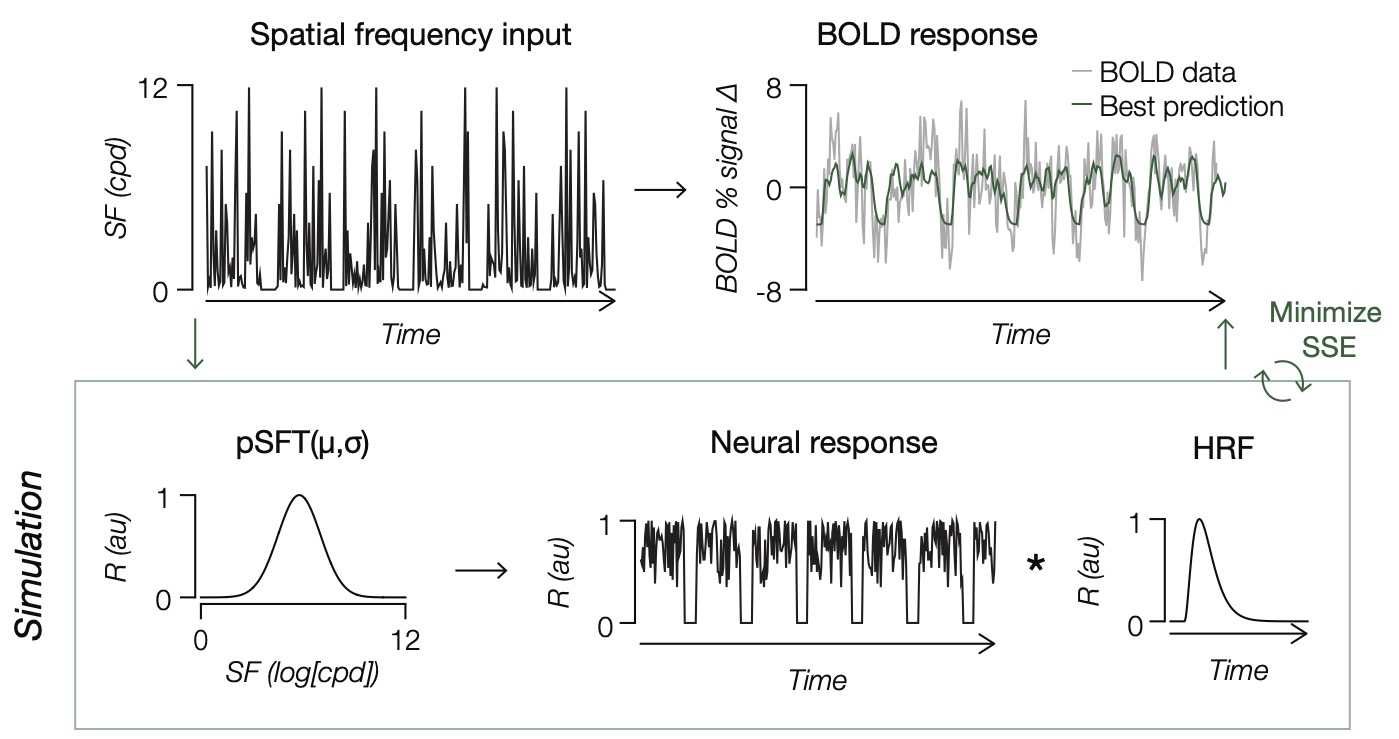
We developed an open-source MATLAB package to provide a standardized, reproducible pipeline for characterizing population spatial frequency tuning (pSFT) from fMRI data. The toolbox facilitates stimulus generation, data collection, and voxel-wise parameter optimization, bridging the gap between raw BOLD signals and interpretable neural tuning curves. It includes a measure-pSFT module for Psychtoolbox-based stimulus presentation and an estimate-pSFT module for fitting log-Gaussian models to voxel data. To ensure computational rigor, we included a validation sub-module that uses synthetic BOLD data to benchmark parameter recovery across varying signal-to-noise ratios. The pSFT approach has been successfully deployed across multiple studies (see below).
Attention Alters Population Spatial Frequency Tuning
Ramirez, L. D., Wang, F. & Ling, S. 2025. Attention alters population spatial frequency tuning. Journal of Neuroscience. https://doi.org/10.1523/JNEUROSCI.0251-25.2025.
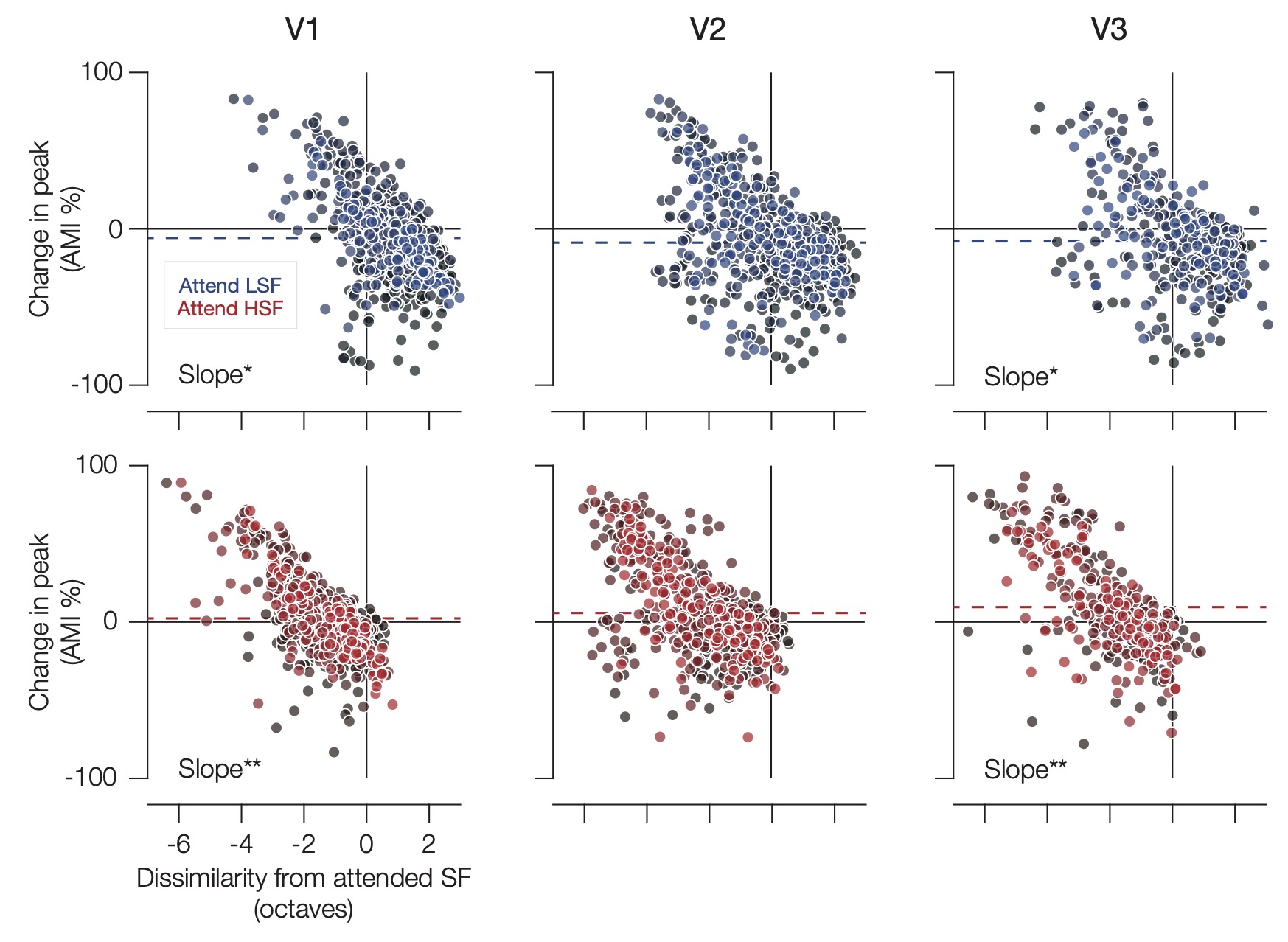
This project utilized pSFT to investigate how feature-based attention reshapes voxel-wise SF tuning profiles in the early visual cortex (V1–V3). By measuring these changes in a task-irrelevant hemifield, we were able to isolate the global effects of feature-based attention as they spread across the visual field. We discovered that attention elicits significant "attractive shifts" in SF preference toward the attended frequency, demonstrating that neural populations flexibly adjust their tuning to prioritize task-relevant details. This work provides direct evidence that voluntary attention can dynamically reconfigure the fundamental building blocks of early human vision.
Emotion Alters Population Spatial Frequency Tuning
Ramirez, L. D., Pan, J., & Ling, S. 2024 “How does emotional arousal modulate population spatial frequency tuning?” Poster. Vision Sciences Society Conference. https://doi.org/10.1167/jov.24.10.912
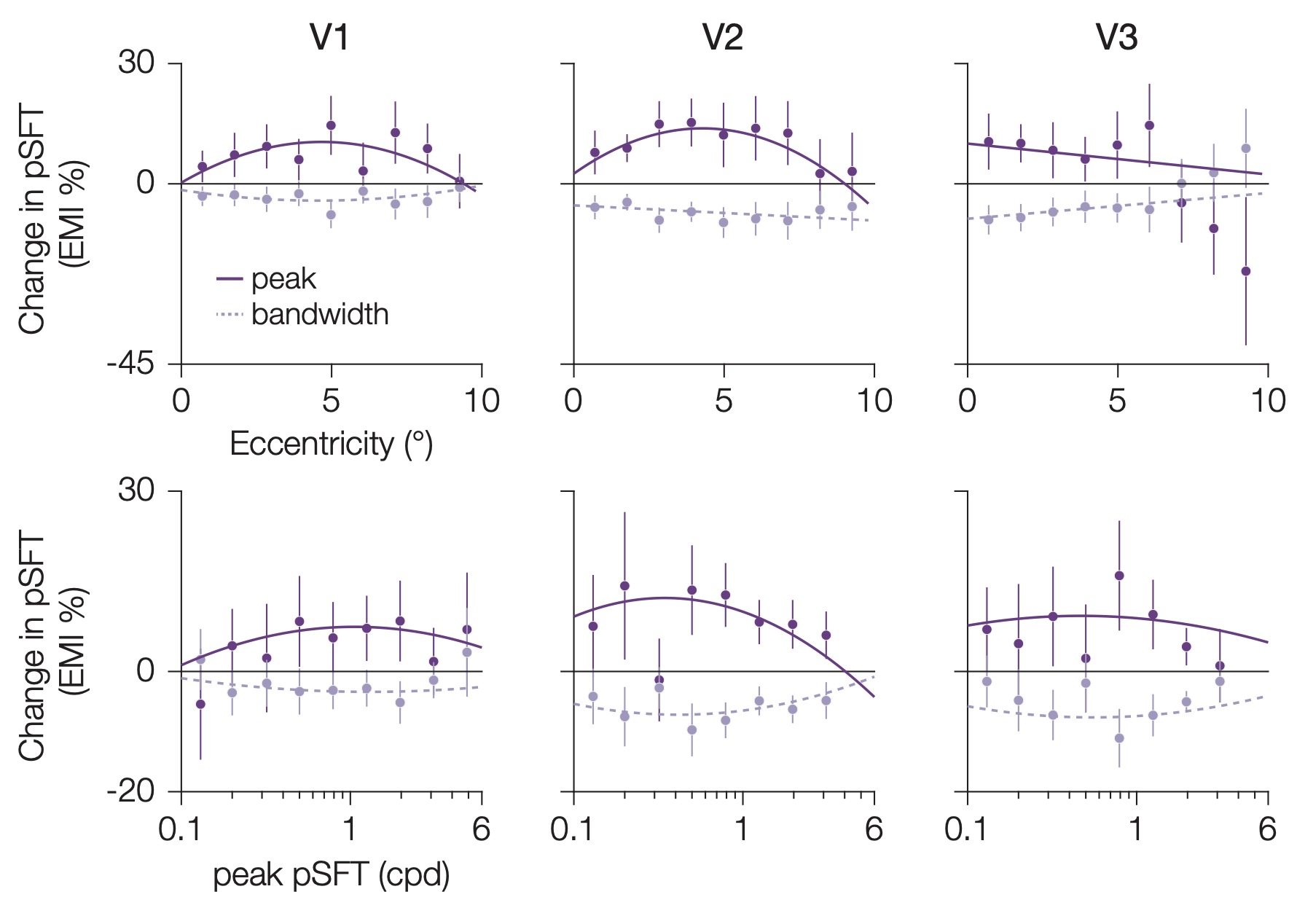
This study used pSFT to measure how negative emotion reconfigures SF tuning. Negative emotion was induced using valenced auditory stimuli while measuring SF tuning in the early visual cortex. Contrary to the long-held belief that negative emotion solely sacrifices fine detail for coarse "gist," we found that negative emotion triggered systematic increases in preferred SF and selectivity, particularly in the extrastriate cortex. In other words, the visual system can dynamically increase spatial resolution to enhance the processing of fine details during states of negative emotion.
Spatial Frequency Tuning Follows Scale Invariance in the Human Visual Cortex
Wiecek, E., Ramirez, L. D., Klimova, M., & Ling, S. 2026. Spatial frequency tuning follows scale invariance in human visual cortex. Journal of Neuroscience. https://doi.org/10.1523/JNEUROSCI.1490-25.2025.
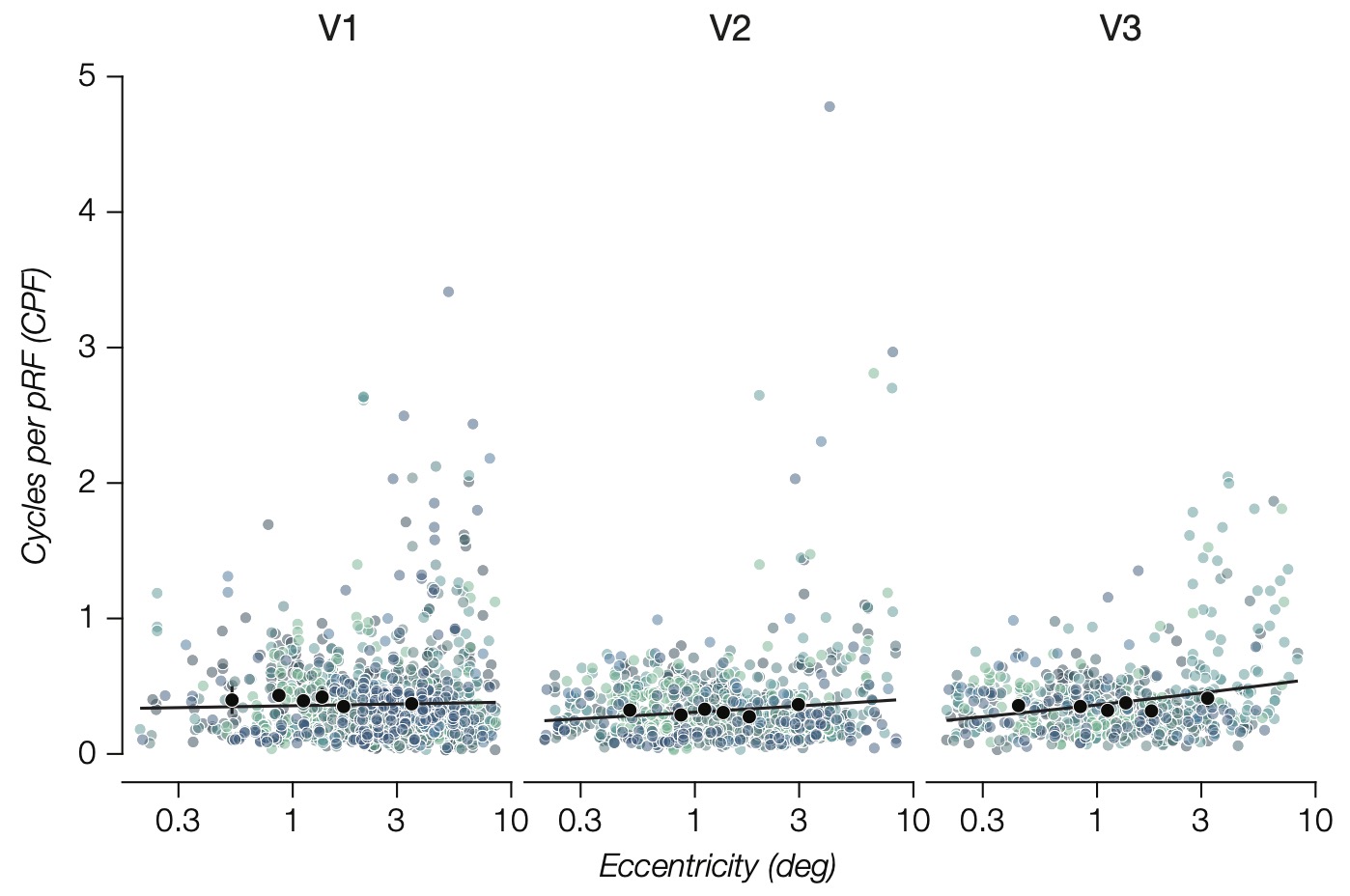
Here we provide a direct test of the scale invariance principle in the human visual cortex—the theory that the resolution of spatial sampling remains constant relative to receptive field (RF) size. By introducing the "Cycles Per Receptive Field" (CPF) metric, we showed that SF preferences scale inversely with population RF size across V1–V3. This project combined population receptive field (pRF) mapping with pSFT to characterize the functional sampling properties of neural populations across the visual field. Our findings validate a fundamental assumption in visual neuroscience and establish a new framework for studying atypical visual development.
Temporal Attention Selectively Enhances Target Features
Ramirez, L. D., Foster, J. J., & Ling, S. 2021. Temporal attention selectively enhances target features. Journal of Vision. https://doi.org/10.1167/jov.21.6.6.
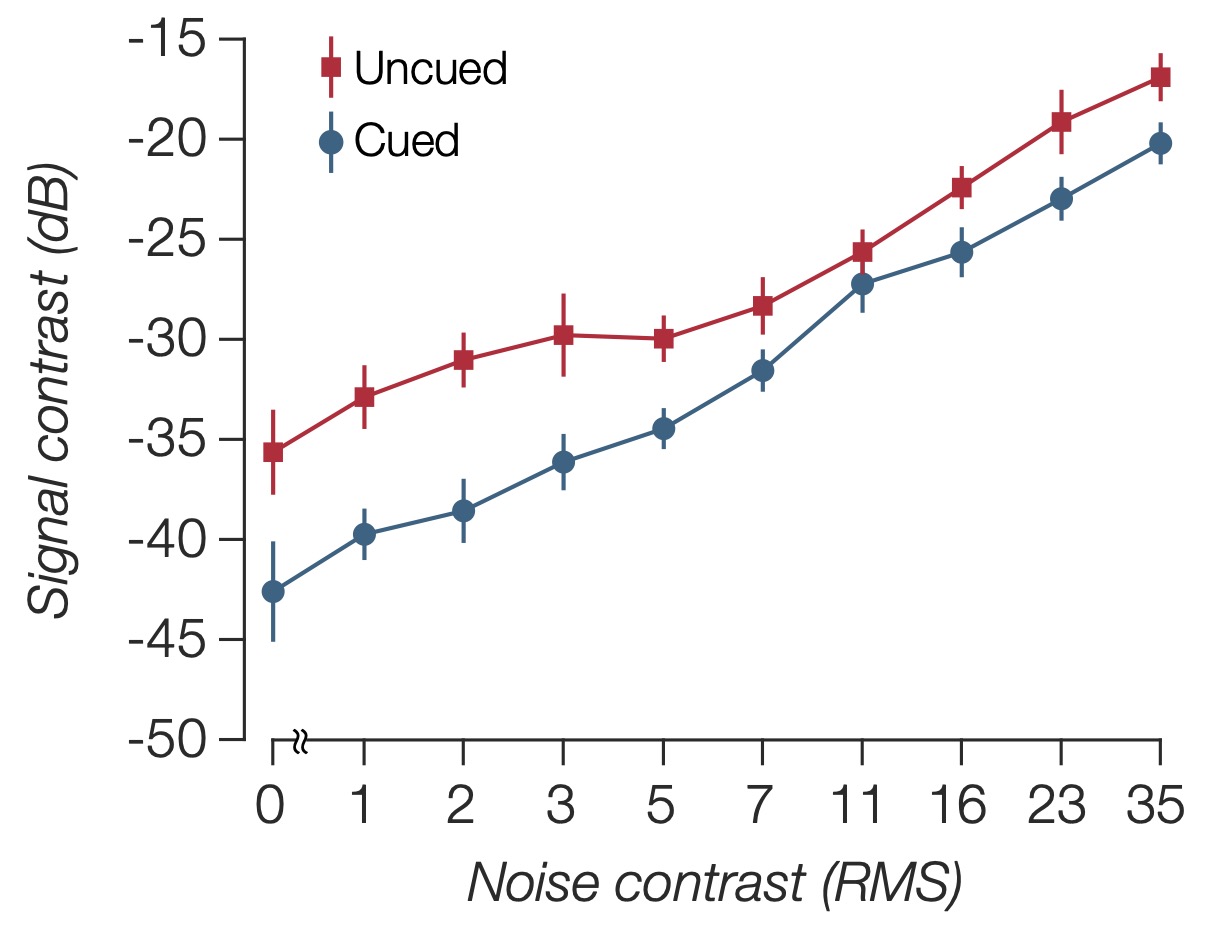
This research examined the computational mechanisms of temporal attention—the allocation of attention to a specific moment in time. Using a fine-orientation discrimination task paired with an equivalent noise paradigm, we teased apart how attention improves perception under varying levels of external noise. Formal model comparisons revealed that temporal attention acts through a combination of signal and stimulus enhancement, selectively increasing gain for target features. By fitting variants of a divisive normalization model to behavioral data, we provided evidence that the brain can selectively "tune in" to relevant signals even when they are embedded in noise.
Last updated: 02.05.2026
- 2026 The Population Spatial Frequency Toolbox Journal of Open Research Software
- 2026 Spatial frequency tuning follows scale invariance in human visual cortex Journal of Neuroscience
- 2025 Attention alters population spatial frequency tuning Journal of Neuroscience
- 2021 Temporal attention selectively enhances target features Journal of Vision
Last updated: 02.05.2026
Invited Talks
- 2023 Experimental Psychology: Cognitive Neuroscience Boston University CAS NE 329
- 2022 Experimental Psychology: Cognitive Neuroscience Boston University CAS NE 329
Conference Presentations
- 2025 How feature-based attention alters representations in human visual cortex Talk. Vision Sciences Society Conference. St. Pete Beach, FL
- 2024 How does emotional arousal modulate population spatial frequency tuning? Poster. Vision Sciences Society Conference. St. Pete Beach, FL
- 2024 Are visual deficits in amblyopia driven by spatial frequency tuning? Poster. Vision Sciences Society Conference. St. Pete Beach, FL
- 2024 Is the loss of spatial resolution in amblyopia linked to a deviation in scale invariance? Poster. Association for Research in Vision and Ophthalmology Conference. Seattle, WA
- 2023 Feature-based attention modulates spatial frequency processing in early human visual cortex Poster. Vision Sciences Society Conference. St. Pete Beach, FL
- 2023 Characterizing the relationship between population spatial frequency tuning and receptive field size Poster. Vision Sciences Society Conference. St. Pete Beach, FL
- 2022 How does feature-based attention modulate spatial frequency processing in early human visual cortex? Poster. Society for Neuroscience Conference. San Diego, CA
- 2021 What mechanisms underlie top-down modulation of human visual cortex? Talk. Writing Your Own Blueprint: The NIH Blueprint Diversity Conference. Virtual
- 2020 Temporal attention selectively enhances gain only for target features Talk. Vision Sciences Society Conference. Virtual
- 2019 Spatial location does not elicit normalization in visual memory Poster. Vision Sciences Society Conference. St. Pete Beach, FL
- 2019 Exogenous temporal attention improves perception via signal enhancement Talk. Boston University Brain, Behavior, & Cognition Student Seminar. Boston, MA
- 2018 Temporal attention enhances visual perception through both signal enhancement and noise exclusion Poster. Vision Sciences Society Conference. St. Pete Beach, FL
- 2016 Development and evaluation of a new test of face perception and face memory ability Poster. Society for Neuroscience Conference. San Diego, CA
- 2016 Evaluation of a new test of face perception and face memory ability Poster. Vanderbilt Summer Science Academy. Nashville, TN
- 2015 Emergence in the Fractional Quantum Hall Effect Poster. New York University Tandon Summer Undergraduate Research Program. Brooklyn, NY
- 2021–present F99/K00 NIH Blueprint and BRAIN Initiative D-SPAN Award
- 2021 Hispanic Scholarship Fund (HSF) Scholar
- 2020 BU Diversity & Inclusion: Inclusion Catalyst Grant
- 2020 HHMI Gilliam Fellowship for Advanced Study Nominee
- 2017 NYU Tandon Achievement in Science and Technology Studies
- 2017 R25 NIH Blueprint ENDURE Fellowship
- 2025 Attention alters population spatial frequency tuning Featured in Journal of Neuroscience, August 26, 2025 (Ramirez et al. 2025).
- 2025 ‘A gut punch’: How U.S. neuroscience trainees are grappling with diversity-based funding flux The Transmitter. Feature by Calli McMurray, Angie Voyles Askham, & Claudia López Lloreda.
- 2021 BU event reflects on neurological impact of racism on Black Americans The Daily Free Press, April 13, 2021.
- 2018 BU Graduate Medical Sciences prompt discussion about minority struggles in STEM field The Daily Free Press, November 1, 2018.